Showing posts with label Drawing. Show all posts

Wednesday, May 11, 2016

Collaborative Grid Portraits


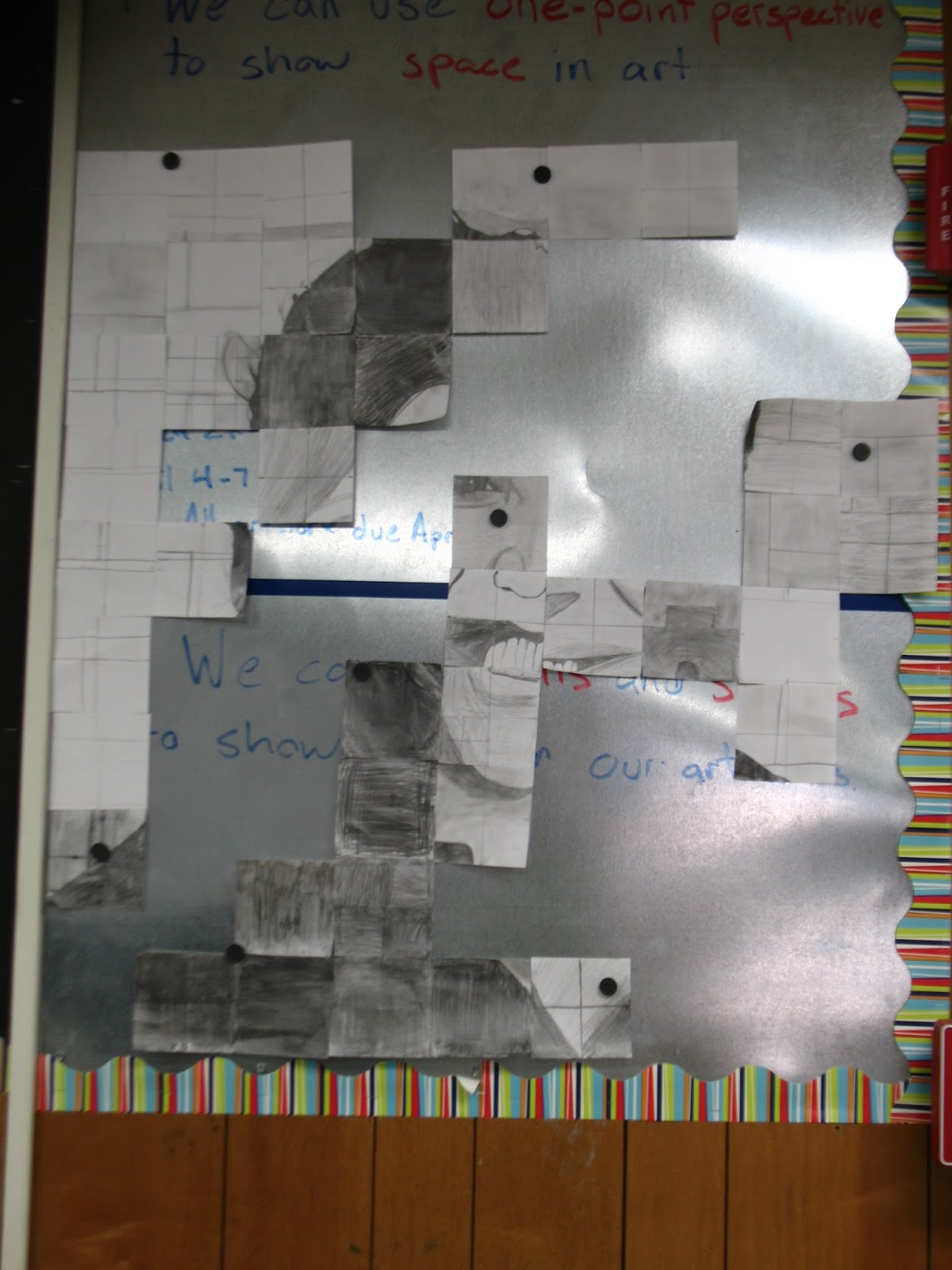
2nd year in a row doing this lesson with 5th Grade. Students learn about Chuck Close, the grid method, and breaking big jobs into small pieces and sharing in the workload to accomplish big things. Last year my 5th graders created two large portraits of our Principle and Vice Principle. This year 5th graders created portraits two other administrators at our school. These portraits are 32"x 40". Students do not know who they are creating portraits of as they are doing it. I keep it a secret. An 8x10 photo is cut into one inch pieces and spread out among 4 classes of 5th graders. Students enlarge their piece of the portrait to 4"x4" using a grid, then complete it with pencil value. Students do the initial layout and piecing/taping together of the squares. I come back when they are done and straighten up some of their seems. It is a lot of fun to watch the students guess who the portrait is of as it comes together. The whole lesson takes about 3 class times (50 minutes each)to teach and complete. After these are done, we give them to the subject of the portrait as a gift.


Students use a grid with the numbers of the pieces written on it as a map while they put the portrait pieces together.


Students lay their one inch square on top of their value drawn piece for comparison.


Sometimes a few pieces get lost, but special helpers get picked to do the missing pieces. Everyone enjoys this project.


Saturday, April 9, 2016

Collage/Drawings with Depth


This wasn't an original idea, it came from the Davis Digital textbook for 2nd grade. It was a great lesson though. Students started with three different sized pieces of construction paper (a great way to use odds and ends pieces from other projects). After coming up with an idea of people doing something together, they drew the people on their construction paper pieces, making sure that the people touched the top and bottom of the paper. We then discussed placement, size, and overlap as tools to create depth. Students then cut out their figures and glued them to a 9x12 sheet of construction paper. Lastly, the student used their construction paper crayons to create a background, preferably with a foreground and background. Here are some examples.
Soccer

Playing with friends

Basketball

Boxing

Swimming

Riding Bikes

More soccer

I love the variety of subjects that the students came up with.

Saturday, January 16, 2016

Make it 3D!


I know I probably shouldn't pick favorites, but the drawing above is my favorite drawing of the week. My 2nd graders started a unit on architecture this week. When given time to draw a building of their own design in 3D, one of my second graders drew this awesome monster gas station. I told them they could draw any kind of building they wanted. What I love about this drawing is the overlapping inside of the gas pump area. We haven't covered overlapping at all. 

This kind of drawing started last year when I taught Kindergartners and first graders how to use diagonal lines to make shapes 3D. They loved it, and yes, we did cover height, width, and depth. What sold them was showing them how to apply this to drawing cars. They went home and practiced drawing cars all summer. Many of them came back as the 2nd grade version of a 3D drawing master. So, for my pretest, they had to draw a square, triangle, circle, and car shape in their art journals, then use diagonal lines to make their shapes 3D. Here are a couple of pretest examples.


Check out that truck. I am impressed.


After their pretest, and before their buildings, we read a bit from our digital textbooks. Our district adopted the Davis Digital art books this year, so I pulled some of the pages up on the Promethean Board. I like to turn the pages into I Spy and Matching games. We discussed what an architect is, and then the time was given to them to design their own building. Here are some more examples.


Thursday, December 3, 2015

3 Valuable Weeks

With the way my schedule is at my school, students come to art once a week for 50 minutes. With that said, this simple lesson took 3 weeks. In the district that I teach in, our curriculum is based on the elements and principles. Part of our fall curriculum for 4th grade is value. I have not seen evidence over the past few years that my students have held on to an understanding of value, so this year I decided to try a new approach. Prior to doing any works of art with value, my 4th graders made value scales using pencil, oil pastels, and water colors.
These media worked great for this lesson since the process for creating values with each one is so different. This also gave me a chance to teach some watercolor and pastel techniques that I have not covered in the past. Students experimented with varying pressure to create values with pencil, adding white and black to a color with the pastels, and diluting their paint with varied amounts of water for water colors. Also, this gave one more opportunity to practice our skills measuring and drawing straight lines with a ruler, something that drives me nuts that most students seem to not know how to do.
Obviously, we used pencil, oil pastels, and water colors, but we also used multimedia paper. This gave an opportunity for me to say "media" a million times and to explain it. Our value scales are just the first stage to a lesson that we are working on currently that is focused on rhythm. Students are using values created with one color in and all three of these media for their first mixed media project of the year. Some good scaffolding going on here. I will post about the rhythm assignment in a couple of weeks when we are finished, so far this has all been very engaging to them, though it doesn't look as exciting. 


Friday, September 4, 2015

Lines of Observation


The second week of school is now over. Time to create my first classroom post. With all of the craziness of the first few weeks of school I am trying to take it a little easy on the students and give them assignments that are challenging but not full of pressure. 

Art Journals

Last year I started having my students make an art journal. This is where we keep all of our "bell work." When the students come into the room and find there seat, we start off class with a 5 to 10 minute assignment to introduce what we are doing for the day. This is usually where they learn vocabulary, and have an opportunity to describe, analyze, interpret, or judge. So, for the first day in class this year we created our first journals by folding in half a 9x12 sheet of manila drawing paper for our cover, and 5 sheets of 9x12 newsprint for the inside pages. Students learned the procedure for their art heading by putting it on the front of their journal, and then were given the task of being a cover artist and designing the cover of their journal. These journals will last us the first half of the school year. Last year I had 3rd grade through 5th grade work in their art journals, this year I am including 1st and 2nd grades as well.

Observation and Line

I am starting my third year as an art teacher now, and one thing that I decided for this year is that my students need more exercise in observing, and creating observational drawings, or paintings, or whatever else we can record observations with. The curriculum in my district calls for starting the year out teaching about lines. So, we had a small assignment this week creating contour drawings. This assignment was given to both 2nd and 5th graders, mostly because I wanted to see what differences there would be between the two age groups, but also because this kind of work scaffolds well into the assignments I have planned for those two grade levels this year.

I sold the students on this assignment by talking about exercising to build strong muscles, and how artist have exercises to build strong art skills. I let them know that we were going to do some artist exercises. After folding our papers into fourths and labeling the boxes, we had four exercises. First was drawing a paint bottle I set on their table using only one line and not picking up our pencils till we were done. Next was doing the same thing without looking at our paper, but focusing on the bottle. For the third exercise, we had to draw only the outline, but could pick up our pencil if needed. Lastly, I gave them the rest of class to do their best line drawing of the bottle, looking for details, and making corrections as needed.

Throughout the process I made sure to give them tips about looking carefully at what kinds of lines made the shape of the bottle, even some talk toward the end about thick and thin lines. My students seemed way more engaged in this than many lessons we have had in the past, and created some very honest drawings. It was a great learning experience for the students and for me.


Here is one of my favorite drawings that came from this exercise. Tons of character.