Showing posts with label Crayon. Show all posts

Saturday, April 16, 2016

Interior and Exterior Buildings

.


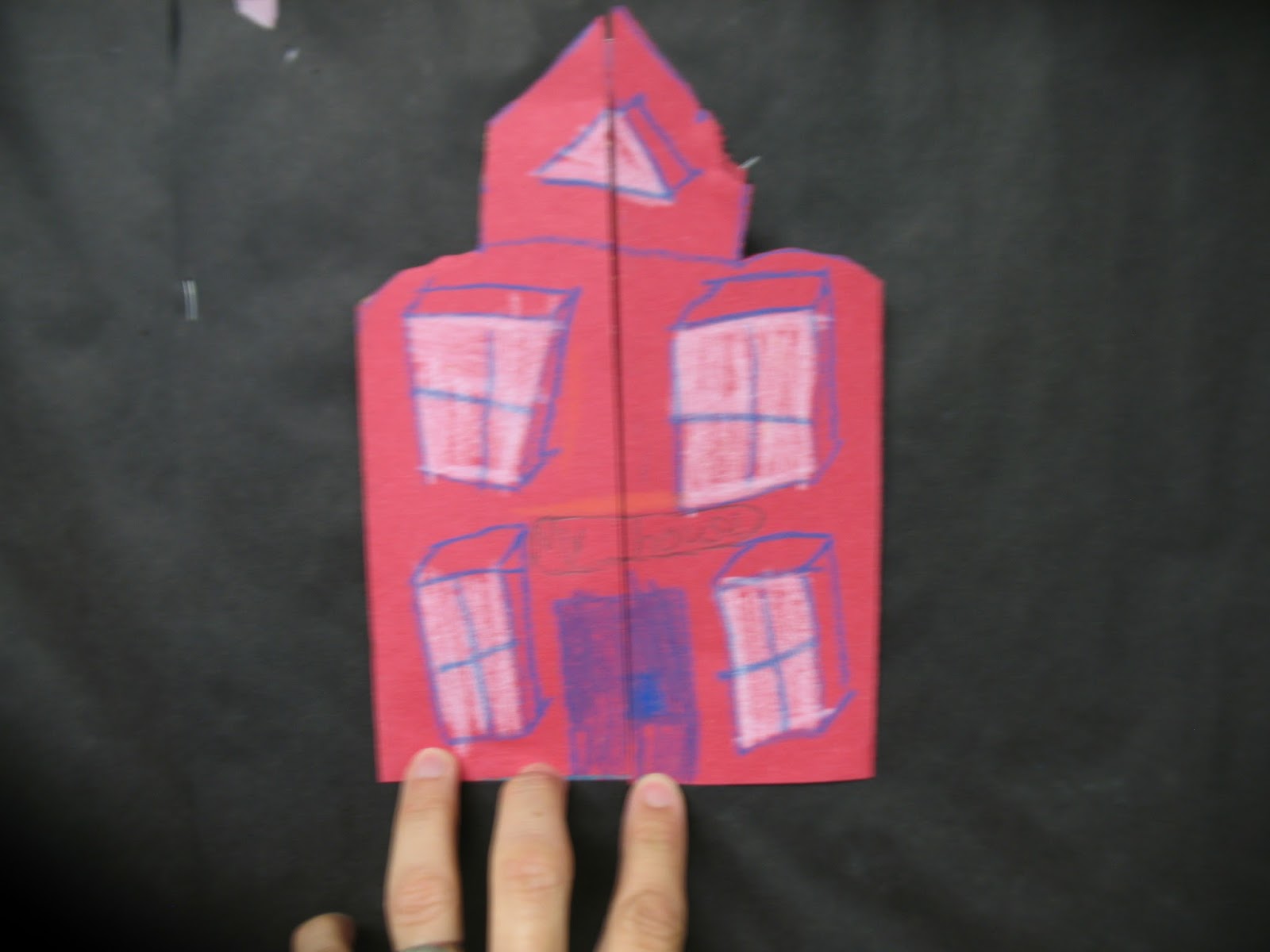
2nd Graders designed their own buildings, inside and out. These were really fun. The students enjoyed designing the inside the most. 

First we folded our paper so that we would have to parts of the front that would open at the center revealing the inside. Next, students drew the exterior of their buildings. I had to really emphasize that the sides of the building had to be the sides of the paper. Some students did not get that and we had to do a bit of taping, but hey, we role with it. After drawing the exterior of their building, we cut the negative space at the top off so that the inside of our buildings would have the same shape as the outside. The previous processes actually took two class periods of 50 minutes, given time talking about architecture and so forth.
After students had finished designing the exteriors of their homes, came the interiors. We discussed what kinds of things we would have inside of a dream house. All sorts of ideas came up. Some of the best ideas were rooms of trampolines or filled with balls, underwater rooms, you name it. students then colored the inside of their houses. 
Materials for this one were simple; construction paper crayons, scissors, and 9x12" construction paper. When they were all completed we lined them up like row houses, creating a little neighborhood.


Saturday, April 9, 2016

Collage/Drawings with Depth


This wasn't an original idea, it came from the Davis Digital textbook for 2nd grade. It was a great lesson though. Students started with three different sized pieces of construction paper (a great way to use odds and ends pieces from other projects). After coming up with an idea of people doing something together, they drew the people on their construction paper pieces, making sure that the people touched the top and bottom of the paper. We then discussed placement, size, and overlap as tools to create depth. Students then cut out their figures and glued them to a 9x12 sheet of construction paper. Lastly, the student used their construction paper crayons to create a background, preferably with a foreground and background. Here are some examples.
Soccer

Playing with friends

Basketball

Boxing

Swimming

Riding Bikes

More soccer

I love the variety of subjects that the students came up with.

Tuesday, December 1, 2015

2nd Grade Lichtenstein Self Portraits


This is one of my favorite lessons. I saw examples somewhere on the Internet last year and thought, "hey that looks like fun". I have learned somethings teaching this for the second year and this year's projects turned out even better than the previous year.

So here's the rundown. We started off by looking at an image of one of Lichtenstein's paintings that is at the Modern Art Museum of Fort Worth. Students identified the painting only had primary colors, looked like it came from a comic book, and told a story. These observations were the basis for our works.

We worked together to create self-portraits that were big on our paper, had good proportions, and had either a thought cloud or a word bubble (we had a fun time discussing the difference). Students were to either write something they would say in a bubble, or something they think about in a cloud. Surprisingly, many students actually followed directions to make the words big enough to read from far away. After making any corrections, students traced their drawings with black sharpie.
The next step was to use multicultural washable markers to color our skin color. I had students test the markers on the back of their papers and hold their hand next to the test spot to find the closest match to their own skin. This always leads to a great discussion on how all people are different dark or light versions of brown and no one is really white or black.

Our final step was adding our primary colors with crayon. In all steps, students were expected to show their best craftsmanship, filling in white and keeping our colors at a unified darkness, as well as trying to make them smooth looking and not rushed.
I love this assignment because it helps me to know a little more about the students personal interests and character.


The student that created this self-portrait always impresses me. She has not spoke a word to one person at our school in two years, but has the most phenomenal artwork.
This may be my favorite from this year. The student really showed his personality.


Monday, September 14, 2015

Color Field Kinder and First

Kindergarten and First grade have always been the two areas that I feel I struggle with the most. This year I am trying a different approach. I have decided to focus more on motor skills and manipulation of media with them. The curriculum that we follow in our district requires that we teach "lines" to these two grade levels for the first six weeks of the year. I decided this year to look at three kinds of lines with them; straight, curved, and zigzag. We will have one production assignment for each kind of line. Starting with straight lines we are looking at the artwork of Gene Davis.

Way back when I went to college the first time, I was introduced to the artwork of Gene Davis in my color theory class. Looking at reproductions in books, I remember not being totally knocked over with enthusiasm. That all changed during a visit I made to the High Museum of Art in Atlanta Georgia during an exhibit which featured works of his, Morris Louis, Frank Stella, and other color field artist. Standing in front of these massive walls of colors changed my entire perspective on the artworks of such artists.

Franklin's Footpath Gene Davis 1972

To try to give my students such an experience I showed them works by Gene Davis, blown up as large as I can with my projector, letting them know that many of these works are even larger in person. The room filled with excitement when I showed them Davis's Franklin Footpath from 1972. This was a great time to have the "what is art?" talk with kindergarten and first graders.

Kindergarten


For my kindergarteners, the main focus was some introductory art skills, mostly folding paper and coloring in an area with crayons until the space is filled and the color is dark.

Students were given 9x12" manilla drawing paper. First they worked on writing their name. Then we focused on folding our paper lengthwise, then lengthwise again. This gave us four basic stripes. Kindergarteners were shown to trace the creases with a light colored crayon. When we started coloring, we started with our favorite color, and worked on slowing down and coloring one stripe at a time. This is some challenging stuff for the second week of school ever (the case for many of my kindergarten students).

We slowed this down enough to cover two times of meeting in my class. Before finishing on the second day, we read A Bad Case Of The Stripes, discussing what an illustrator is, and the illustrations of David Shannon.

First Grade

First graders also learned a new skill, one I have noticed even middle schoolers struggle with, drawing a straight line with a ruler. In the past I have waited till second grade to use rulers with my students for drawing straight lines. However, last year I took a chance with kindergarten and first grade, teaching them how to draw forms (3D Shapes). They blew my mind and were even able to draw 3D houses and even cars. This year when they came back to school you could tell that they had been drawing 3D all summer.


Excited to see their progress, I knew they could handle straight lines with rulers. Sure enough, we practiced a few times on the back of their paper and they got it. The trick I told them was making a big L with the hand they do not draw with, then putting it in the middle of the ruler and pushing down super hard, like the Hulk, then keeping their pencil against the ruler and dragging it from the top to their chest. I told them that I had to see their muscle on their ruler hand. This worked great.


Like the kindergarteners, my first graders also had to work on coloring darkly with crayon and filling the space so that we could not see the paper. I tried to encourage them to make some fat stripes and some skinny, but most still played it safe and made stripes that were fairly uniform. This was a simple project, but full of skills that will help with everything we do in the future.